
Rebuilding U.S. Machine Tool Sector

”Full Set Type”: an economic structure in which all industrial sectors are contained at certain level in one country.
-- Japan’s Ministry of Economy, Trade and Industry/METI
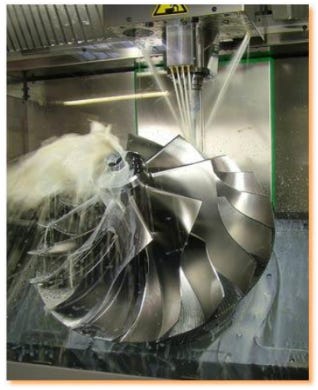
The rebuilding of an American "full set" economy will require the rebuilding of the U.S. machine tool sector. Making the U.S. a manufacturing superpower, building hundred is not thousands of nuclear power plants, will require an expansion of U.S. machine tool capabilities analogousness to the expansion required to fight and win World War II.
The Reconstruction Finance Corporation (RFC), through the Defense Plant Corporation, financed billions of dollars of industrial expansion leading up to, and through, World War II. One billion dollars - a much bigger sum in that day - went, "into plants to manufacture steel and iron and hundreds of foundries and small auxiliaries of the industry..."
...The Corporation allotted many millions for plants and machinery which made tanks, guns, bombs, shells, and a thousand other implements of war. It also financed the building of ships and dry dock facilities. Tens of millions went to enlarge production of chemicals and synthetics, from old-fashioned bleaching powder to ultramodern Plexiglass.
To stimulate production of machine tools we made advances to manufacturers against purchase orders up to 30 percent of the delivery price. These agreements instituted the day after pearl Harbor, were in effect underwriting. The machine-tool commitments ultimately aggregated almost $2,000,000,000. They provided tool manufacturers with supplementary working capital.
For machinery to equip one hundred and nineteen new plants assigned to make lenses for optical instruments Defense Plant spend $217,000,000. Transportation projects took $335,000,000...
--From Fifty Billion Dollars, My Thirteen Years with the RFC (1932-1945), by Jesse H. Jones with Edward Angly (1951), The Macmillan Company
To rebuild the U.S. today as a manufacturing superpower, exactly such a similar size of investment (in today's dollars) is required, through a similar federal credit-issuing institution as the RFC.
Return to the Machine Tool Principle
...But the most perplexing of these declining industries are the ones that are fundamental to making other manufactured products. These are industries like machining, machine tools, mold making, tool and die, semiconductors, forging, and foundries. It is difficult to see how we can achieve a manufacturing renaissance while these critical industries continue to decline:
"Machine tools. These are the master machines that make other machines and products. ...
"The numbers for foundries, machine shops, machining and machine tools continue to decline and beg the question of “How can we ever have a manufacturing renaissance if we lose these critical industries?”
-- From Is US Manufacturing Losing Its Toolbox? by Michael Collins, Industry Week, August 16, 2019 1
Machine tools are essential to every industry. They are the machines that, in the hands of skilled operators, produce machines. Not only the machines of today or yesterday, but the machines we will need tomorrow. Machine tools are then utilized in energy, automotive, aerospace, electronics, and precision engineering, to name a few areas.
Today there is a vast array of machine tools, including CNC (computer numerical control), additive manufacturing, and hybrid machine tools that combine tradition subtractive machining (that begins with a block of material and removes materials with a series of cutting tools to generate the finished product) with Additive Manufacturing in a single one-step process. There is also the ongoing automation of increasingly sophisticated machine shops, with 5G and "lights out" manufacturing.
There is also a wider array of materials, from a wide spectrum of plastics, metal alloys, and composites, including ceramic composites. These all require their own specialized sets of tools and lubricants, and an increasing capacity to adapt, adjusting machining speeds, the applied tools, and lubricants to changing circumstances encountered in the increasingly complex materials utilized.
Return to the Machine Tool Principle
The key to grasping the importance of this sector is located in what physical economist Lyndon LaRouche termed The Machine Tool Principle. In what is rightly termed the strategic machine-tool sector, our scientists and engineers transform new discoveries of physical principle into machine-tool designs. The prototype applications are tested and, if viable, scaled up to full manufacture of ensuing products. Out of that process, including the very problem-solving that comes with the scaling for manufacture, also come new spin-offs and new inventions, which along with new skill sets, that emerge up and down the production process. The consequences of these inherently non-linear and cascading social & constructive processes ultimately promote dynamic developments in the culture and science of society itself.
Truly, this is a vital process of growth and transformation. A subjective 'conveyor belt' of human individual discovery of physical principles, brought about first through carefully designed crucial scientific experiments. It translate into prototypes and machine designs, and then the new, transformative "machine tools" produced by machine builders, with consequent "leaps" brought about in the productivity and health of society at-large.
The skilled tool & die makers and machinists at the National Institute of Standards and Technology’s machine shop exemplify this, collaborativing with their NIST colleagues in building their research prototypes. As pointed out, an engineer might be able to “do a lot of nice things on CAD [Computer Aided Design], but it doesn’t mean they can make the part work. Those might just be pretty pictures.”
It is in the machine shop that it is quickly learned if something is or is not coming together, as, “machinists in the shop are quick problem-solvers.” 2
Without the rebuilding of American strategic machine-tool design sector in particular; without a simultaneous return to Classical forms of education; without fostering the positive federal and state role in building new infrastructure; our nation cannot escape the decay of its physical economy. If we 'flip the script' once-again however, there are no limits to growth!
https://www.industryweek.com/supply-chain/article/22028096/is-us-manufacturing-losing-its-toolbox
https://www.nist.gov/blogs/taking-measure/nists-invention-machine-making-perfect-parts
Always right on the mark and very informative.