
GOT POWER?

As this article is posted, the Trump administration, Westinghouse, Brookfield Corp. and Cameco have announced, with Japanese investment funds, an agreement to build a fleet of Westinghouse advanced nuclear reactors in the US. Where does the USA now stand in building out electrical energy capacity? This post answers how much new baseload power is in the works -- right now -- excluding unreliable wind, solar and storage batteries.
The nation is in a declared national energy emergency, and the Trump administration, states, public and privately-owned utilities, multi-state energy providers, and AI “hyperscalers” are intent on ramping up electric power-producing projects, with projections that electrical power capacity must increase by as much as 25% by 2030 and over 75% before 2050 -- approaching a doubling of electrical power capacity within a single generation of Americans. This conservative figure will be a profound and dramatic transformation of the US physical economy. The implications may not have sunk in, as it comes after literally decades of deliberately-engineered, zero-growth conditions in both the US electricity load and in the total utilization of US primary energy resources such as coal and natural gas, used to produce gasoline, jet fuel, distillate fuel oil (diesel), methanol and agricultural chemicals, and directly as a feedstock.
So, in terms of electrical energy capacity, how much is now set in motion? Really in the pipeline? It is existential, as the USA is building up-and-out of a deep, deep hole.
In this Substack post the building process is caught “in mid-motion,” a snapshot of projects that are either now set to start construction by 2030 (in the planning queue), are already under construction, and those projects coming on line, in the 2025-2030 time frame. As the new US government, Westinghouse, Brookfield and Cameco “strategic partnership” shows, all is undergoing change by the day.
In the Works
Drawing on a number of publicly available reports, there is now approximately (~) a total of 100-160 gigawatts1 of baseload, 24/7 power plant construction in the pipeline. This was before the latest Westinghouse announcement, October 29th. Again, that is now in advanced planning to begin construction, already in construction, or slated to be completed, by 2030. This total adds up across the categories of Natural Gas, Nuclear, Coal, Hydro, and Geothermal.
Here, the figure of ~ 140 gigawatts is used as a conservative working figure, “averaging out” the forecasts given in different professional reports and factoring in the latest Trump administration-Westinghouse announcement.2 As a result of these important projects, the net gain in baseload power to the US electrical capacity will total a net gain of ~ 100 gigawatts. By comparison, there was less than 25 gigawatts of capacity added over eight years, 2016 through 2024, which included over three gigawatts of added nuclear power. (This figure excludes non-baseload gas peakers/simple-cycle plants of some ~31.2 GW)
Net gain is an important concept to recognize here, because a significant percent of new baseload power plants being built-out over the next five years will be replacing currently aging plants. Power plants have definite life cycles. So despite decisive action by the President’s National Energy Development Council and the Department of Energy (DOE), such as reversing planned but precipitous closures of perfectly fine power plants utilizing “beautiful clean coal,” and DOE and utility deployment of resources to upgrade existing, aging coal fired plants, there are forecast some to be ~ 35-45 gigawatts of US electric production capacity that is slated to be retired in the next five years.
That production capacity will be replaced but will not be a net gain to US electrical capacity, except to the extent the replacements add capacity and/or are more efficient. (The technical life of combined cycle gas turbine (CCGT) can be 25-30 years. However, proper maintenance and regular checkups can extend the lifespan to 45-50 years. Likewise the life cycle of existing US nuclear power plants can be 80 years or longer. These life spans compare to 20-25 years for wind and solar.)
As the reader can see, retirement/replacement is a significant part of the ~ 140 gigawatts of projected, baseload capacity construction in the pipeline. The total net additional electric capacity being added -- minus plant retirements and replacements -- is the range of 100 gigawatts.
Further, half of the ~100 gigawatts of this net, new baseload capacity now in the pipeline is forecast to be off-the-grid, behind-the-meter power plant builds. These off-grid builds add up to ~ 40-60 gigawatts. This is, of course, being driven largely by “hyperscalers” and their burgeoning AI data centers, but also by other industries that require power reliability 24/7.
So the reader can do the math. New baseload power to the US power grid itself is now forecast as being in the range of ~50 gigawatts. The total of net gain in total electrical power capacity, combining both that to-the-grid and behind-the-meter, is 100 gigawatts. This is not chump-change, but it is not yet the sea-change required. Even over the short term, a Wood Mackenzie October update finds that utilities, “have committed to twice as much new large load demand as generation is expected to be built.”
President Trump and his administrations know that if the USA is to power what President Trump rightfully promotes as, “the America First Policies required to create GREAT jobs, Cut Taxes and Regulations, and Champion our nation’s Golden Age,” the power grid must be doubled “at a minimum” and “really triple.”
If the USA is to double its manufacturing production, and likewise its total industrial production, along with corresponding improvements in hard infrastructure and employment, for that purpose alone a thousand gigawatts of baseload electrical capacity, from all reliable sources, must be added to the grid.
By Executive Order, President Trump has himself directed an increase of the USA’s nuclear grid by ~300 gigawatts by 2050, a quadrupling. To drive the process, the President has ordered licensing sped up, increased Generation IV fast neutron reactor testing at the national laboratories, deployment of small advanced nuclear reactors on US military bases and federal lands, the restarting of US nuclear fuel reprocessing and recycling (not done since the 1970’s), along with increasing nuclear fuel production and processing. He also directs the Department of Energy (DOE) to designate AI data centers as critical defense facilities and tasked the Secretary of Energy with utilizing all available legal authorities to site, approve, and authorize deployment of advanced reactors to power them as well.3 In contrast, BloombergNEF has projected an increase in U.S. nuclear power capacity to 159 gigawatts by 2050. Bloomberg will once again have to eat their words.
In Flux
Given the declared national energy emergency, the reader should not think for a minute that the approximate one hundred and forty gigawatt figure, of new baseload energy, is a settled goal. Again, as with the recent US/Westinghouse/Brookfield/Cameco deal, all changes in the twinkling of an eye! Westinghouse had made a public commitment to President Trump, at the Pennsylvania Energy and Innovation Summit in July, that it was committed to building ten advanced nuclear AP-1000 plants in the USA.
South Korean companies are also expected to soon announce a partnership with Westinghouse, to jointly build nuclear reactors in the United States and Europe. South Korea already builds nuclear power plants in four and one-half years. (See this writer’s post on September 15the post, linked at the end of this article.) There are other such public/private partnerships and initiatives, including those organized through the US International Development Finance Corporation (DFC) and other vehicles, such as a proposed “sovereign wealth fund.”
Small Modular Reactors
There are ~ 2-5 gigawatts of projected power to come on-line from Generation IV small modular reactors by ~2030, and this figure is subject to rapid change as well.
In early September, the federally-owned Tennessee Valley Authority (TVA) and ENTRA1 Energy (ENTRA1) announced the signing of an agreement “to advance the nation’s energy security and maintain America’s leadership in nuclear technologies”:
Under this agreement, ENTRA1 Energy will collaborate with TVA to develop plants to provide TVA with up to 6 gigawatts of new nuclear power generation on sites in TVA’s seven-state region through the deployment of six ENTRA1 Energy Plants...
...As NuScale’s strategic partner, ENTRA1 Energy drives the deployment, financing, investment, development, execution, and management of ENTRA1 Energy Plants™ with NuScales SMRs inside. The TVA and ENTRA1 Energy partnership is an important first step to advance deployment of advanced nuclear technology in America with ENTRA1’s immediate strategy to utilize NuScale’ s SMR equipment inside ENTRA1 Energy Plants™.”4
This is an exploratory agreement to assess the feasibility of the project, not a guaranteed deployment, but the agreement underscores the aggressive approach now coming to dominate federal decision making. NuScale announced, “its strong support for ENTRA1 Energy’s American landmark agreement with the Tennessee Valley Authority (TVA) to deploy up to 6 gigawatts of NuScale SMR capacity across TVA’s seven-state service region—the largest SMR deployment program in U.S. history.”
Further, the Secretary of Energy Chris Wright and the Department of Energy have just released their fusion energy perspective,5 aimed at “Powering the Future.“ The fifty page report is agressively titled, “Fusion Science & Technology Roadmap: BUILD, INNOVATE, GROW,” and flexibly targets First-of-a-Kind (FOAK) fusion energy plants, that will deliver fusion to the grid, to begin being built by 2035. It lay out provides a format for federal partnership, including national labs, with US private fusion energy companies.

AI Role
On July 23, 2025, the White House unveiled “Winning the Race: America’s AI Action Plan,”6 a roadmap for the Trump Administration’s AI policy priorities, driven by the administration’s national security concerns.
To date surging AI/data center demand is projected to add 35–50 GW of total U.S. load by 2030, as projected by both Goldman Sachs and IEA. As already stated, about half of the projected, new baseload electrical capacity is coming from off-the-grid, behind-the-meter power plant builds.
To provide some basic background here, data centers supporting advanced AI workloads now routinely require over 100 megawatts of power capacity, with some projects starting to require over a gigawatt or more. These gigawatt-sized projects include XAI’s 1GW+ “Colossus” projects in Tennessee (and Mississippi), Open AI and Oracle’s multi-GW “Stargate” program in Texas (and elsewhere), Meta’s 5 GW “Hyperion” project in Louisiana, and Fermi America’s 11 GW “Hypergrid” campus, also in Texas.
The current red-hot, competitive market for data centers and AI data centers is such that “hyperscalers” must necessarily bypass the US power grid queues. Buying from regional power systems can now require 3–5 year waits for availability. This means these hyperscalers have turned to building their own on-site, “behind-the-meter” power generation capacity. Further, their behind-the-meter power must be predominately baseload power to insure 24/7 reliability.
Renewables alone can’t even begin to meet 24/7 AI needs -- without massive and costly battery storage. Further, that battery storage can only be counted on to provide power for a maximum of just 24-48 hours, which doesn’t help if the wind and/or sun goes away for days and days.
That means natural gas powered plants or nuclear power are required, and even natural gas plants are not easy to get built right now, as there is -- suddenly -- a three to five year queue to buy the big turbines required from GE Vernova, Mitsubishi or Siemens.
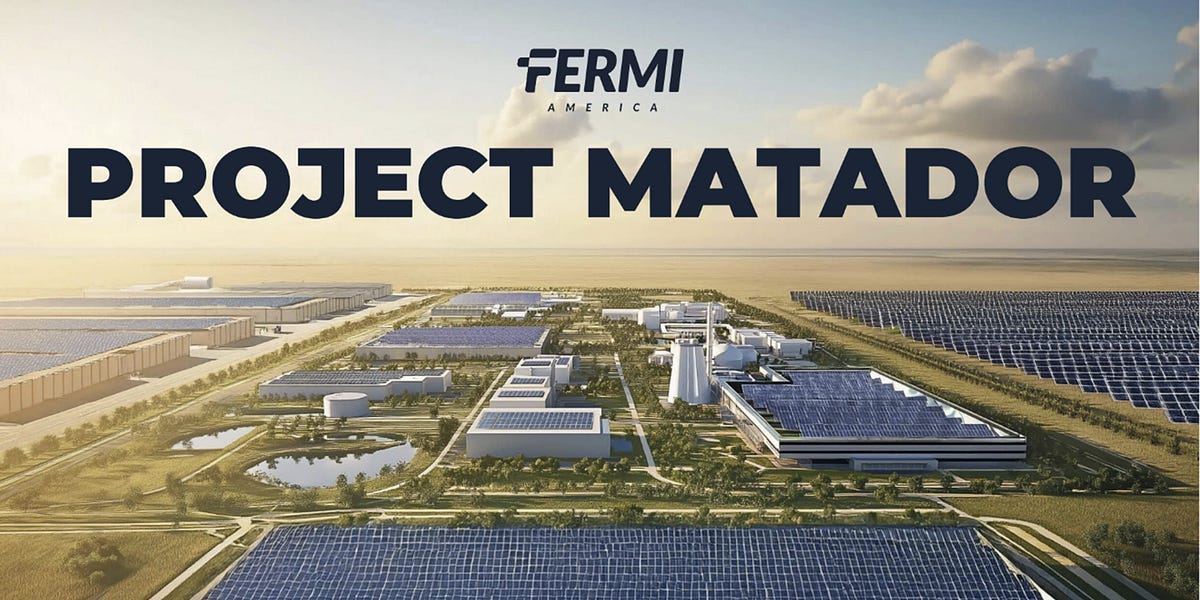
To get around that long gas turbine queue, Fermi America’s Project Matador in Amarillo, TX has purchased refurbished, used turbines, and is additionally buying a number of turbines from Siemens ‘out of the box’-- returned from a project that fell through in Suriname!
XAI has another strategy to build its Colossus projects in Tennessee. To deploy faster than peers, xAI has turned to rental turbine companies.
To be clear, the “behind-the-meter” electricity production is not just going to data centers of various types. Other industries such as the US chemical industry have, and continue to build-out, behind-the-meter electricity generating capacity. For example, if one is using natural gas as a feedstock, it often makes sense to also use a percent of the natural gas the plant is buying to also power gas turbines that produce the electricity the plant needs. It is cheaper and more reliable than buying from the local electrical utility or an energy provider. SMR’s are also coming into play in this area.
Solar and Wind Set to Systemically Destabilize the US Grid?
Setting aside the off-grid power, the continued, massive expansion of solar and wind energy -- solar now in particular -- is enormously complicating the expansion and future stability of the US grid system. Some 300-400 GW (!!!) of destabilizing solar and wind power is still projected to be coming onto the grid in the next five years. For one, the AI consulting firm ICF is cited in the Wall Street Journal as forecasting that the U.S. will deliver almost 80 gigawatts of new generation starting in 2027, doubling the average pace of the past five years -- and two-thirds of that is totally- unreliable solar!
That is a big problem, as many readers may already recognize, because solar and wind energy can destabilize the nation’s alternating current (AC) power grid, primarily because of their intermittency, which causes supply-demand imbalances and frequency fluctuations, but also their “lack of rotational inertia.” Rotational inertia in turbine-generated AC electricity is maintained by the turbine rotor assemblies that may weigh 45-90 tons. The absence of this rotating mass (the rotor and shaft of the turbine that translates kinetic energy into mechanical energy via a generator) means that the “solar inverters” that are substituted lack the built-in inertia to keep the US grid carefully stabilized at 60 Herz, that is the alternating current (AC) that completes 60 cycles per second.
Intermittent solar output varies with weather and time of day, potentially creating over-generation during peak sun or wind, and under-generation, as with solar going away at night or due to cloudy weather. Any such voltage deviations quickly spells potential or actual disaster because instabilities can “cascade,” causing a shutdown large sections of a grid -- or an entire grid as happened in Spain in April, 2024.
Transformation of the US Physical Economy
Now all of these developments are not something to be observed from the bleachers in cynical, apolitical terms. The outcomes of the 2026 US elections will be key to determining the support that the Trump administration -- and future administrations -- will have to move forward with a US manufacturing and industrial renaissance. To make the USA a manufacturing superpower. The nation must accelerate as well as consolidate the drive for a massive up-shift in total electrical power production, as the USA also grows its use of “beautiful clean coal,” natural gas, and other forms of reliable energy. Accomplishing all this and more certainly requires broad support in the US Senate and House, support which is clearly not yet present!
See the September 15th Physical Economics Substack post, The President Captains the Ship to the Promised Land, covering the emerging US-South Korea nuclear energy partnership:
The President Captains the Ship to the Promised Land

The reader will find, below, a YouTube link to the author’s presentation made just days ago. Hosted by Kesha Rogers, it was made to Promethean Action activists, via Zoom, on October 11th. One hour in length.
A single gigawatt (GW) of electric power capacity -- one thousand megawatts which is roughly equivalent to the capacity an existing nuclear power plant -- can support anywhere from 300,000 to 725,000 homes, with the lower end being more realistic due to factors like peak usage and distribution loss, and the higher end assuming steady consumption throughout the year. As a real-world example, one gigawatt of power can support approximately 200,000 to 250,000 homes in Texas in heat of the Summer. Air conditioning is perhaps the most underestimated factor in economic transformation the American South and Southwest!
To come up with a relatively accurate figure has required peeling the onion. First, because changes are happening in this area at a fast pace. Further, US Energy Information Agency (EIA) projections this writer found are backward looking, still being based on 2024 ‘Biden’-era “green” scheming. In addition, NERC and FERC are focused on electrical power generation to the US power grid. They are not closely assessing new “behind-the-meter” (off-the-grid) major capacity, which is now being ordered-up by AI “hyperscalers” such as Meta, Goggle, xAI and OpenAI, and supported by the Trump administration.
Ironically, AI searches -- utilizing, for example GROK -- are also problematic as these tools rely on the same sources, and otherwise have their own biases, and a careful refinement of inquiry and examination of cited AI sources is necessary. BloombergNEF, Wood McKenzie, and other private-sector forecasts are, of course, folded into this author’s figures, but also new, real-world developments. The help of readers is sought in producing reliable reports going forward!
https://www.energy.gov/ne/articles/9-key-takeaways-president-trumps-executive-orders-nuclear-energy#:~:text=2.,takes%20to%20test%20advanced%20reactors
https://www.tva.com/news-media/releases/tva-and-entra1-energy-announce-collaborative-agreement-in-landmark-6-gigawatt-nuscale-smr-deployment-program--largest-in-u.s.-history
https://www.energy.gov/sites/default/files/2025-10/fusion-s%26t-roadmap-101625.pdf
https://www.whitehouse.gov/wp-content/uploads/2025/07/Americas-AI-Action-Plan.pdf
Agreed! Thank you Maria for sharing your thoughts, and your American can-do spirit is much appreciated!
Thanks for a most thorough report, as citizens we must back our president and build our crumbling grid back to and beyond what it was. This is a surmountable task.