
Reversing the Flow - From Speculation to Production
Capital For a Manufacturing Superpower

The asset stripping of the US physical economy is ending. Now a tremendous amount of US capital -- along with a great deal of announced foreign capital -- is in the process of being coaxed ‘off the sidelines’ and invested into the real economy of the USA.
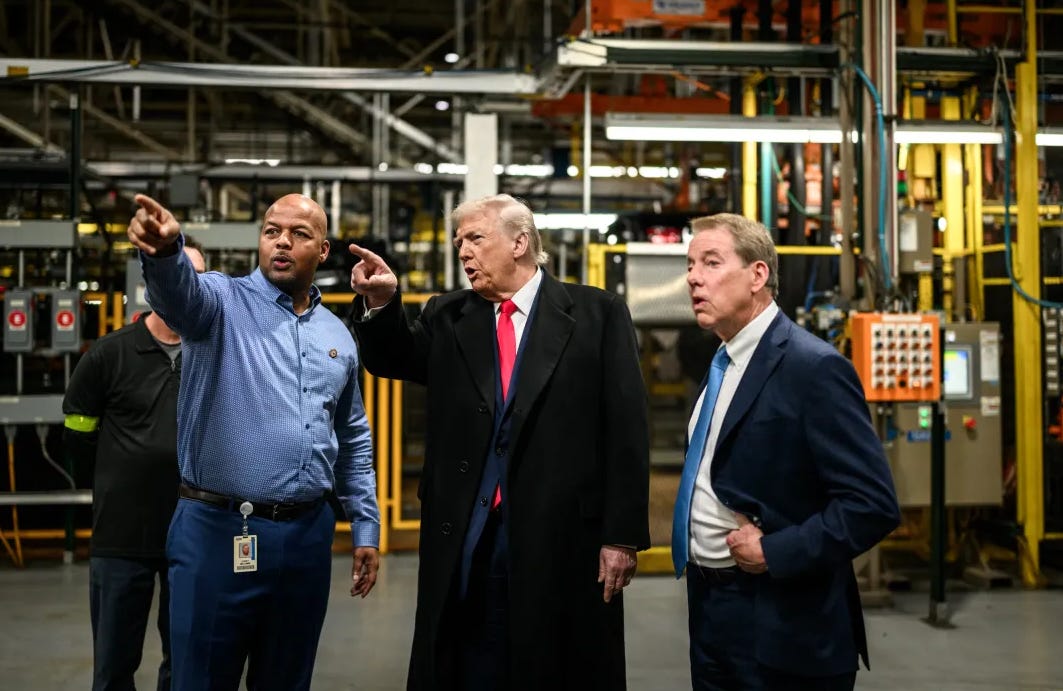
Much of this is occurring just behind the headlined stories your neighbor sees in both social media and legacy media. Yet these heady capital investments are the real story to be ferreted out, behind those blaring headlines, including about oil.
While financial predators kick and scream, capital investment is being encouraged to leave short term, ‘capital light’ speculative investments behind, and instead “go long” -- with investments into energy, mining, heavy industry, and manufacturing. It is a new world!
This movement of capital into physical production is also a consequence of the often-hyped “high volatility” and “chaos” in today’s “financialized” markets, ironically attributed to an “unpredictable” President Trump. Since November, 2024, it has become increasingly clear to many, many market players - bankers, brokers, fiduciary managers -- that their fast gains are subject to sudden reversal. The leveraged nature of speculation itself has insured, for example, the shudders of doom running through the private equity and private credit (“shadow banking”) space.
Leverage Reverses
High frequency trading, private equity and even exchange traded funds (ETF’s) are losing their luster. This was experienced following Trump’s announcement of Liberation Day on April 2nd and during the tariff negotiations that followed:
The stock market doesn’t like uncertainty, as it dropped precipitously when new tariff plans were announced and then rebounded as the plans were paused to negotiate the deals. Like the movies, it feels like we’ve been on a high-speed chase through the steep hills of San Francisco.1
If outsized, quick-buck profits are increasingly scarce through a remaking of yesterday’s speculative “markets”, one might just have to look a little further out. Less immediately profitable, ‘fundamentals driven’, investments increasingly are seen as providing some long term rewards.
Pulling Capital Out of Financial Speculation
It might be hard to believe, but investors are now being advised to look past market noise and instead focus on high-quality, dividend-paying stocks, utilities, and industrials. This is associated, once again, with discipline, patience, and “adapting to the evolving landscape, rather than chasing short-term wins.” Infrastructure is, now again, a buzz word, but not seen as something the nation sorely needs to invest in. Rather investment in infrastructure bonds is having its day as financial advisors suggest, “renewed emphasis on holding quality assets” and, “maintaining a long-term perspective to withstand volatility”.
Active account managers, at banks and investment houses, are pivoting. Should the reader doubt it, here is just one sentence from a Merrill Lynch missive to investors: “Look for high-quality, dividend-paying stocks, utilities and industrials to lead, while technology and financial shares stabilize.”2
Investment managers are finding that volatility has increased the need for costly hedging, which, though maintaining a financial house’s investment flow, increases costs and cuts into profits. Perhaps, the thinking is, it would be better to move to safer ground. The content of JP Morgan’s 2026 Long-Term Capital Market Assumptions - 30th Annual Edition publication is indicative, for those who might want to take a look.3
Also indicative is the public hand wringing of JPMorgan Chase CEO Jamie Dimon -- soon to retire? -- worrying publicly about the potential of a ...financial collapse!
The Markets Are Being Rewired
The intention of this Physical Economics post is to bring an even broader and more dramatic sea-change in capital investment front-and-center. Four examples are discussed: power plants for AI data centers; implications of the new federal rules governing the “Big Five” Defense Primes; the US nuclear & fossil fuels insurgency; and the coming denouement of the globalized metals commodity markets. The reader will see that the Trump administration is effectively deploying a wide range of tools to singular purpose, and doing so in a systematic -- not chaotic -- way.
1) AI Investors Will Now Finance Real Power Plants
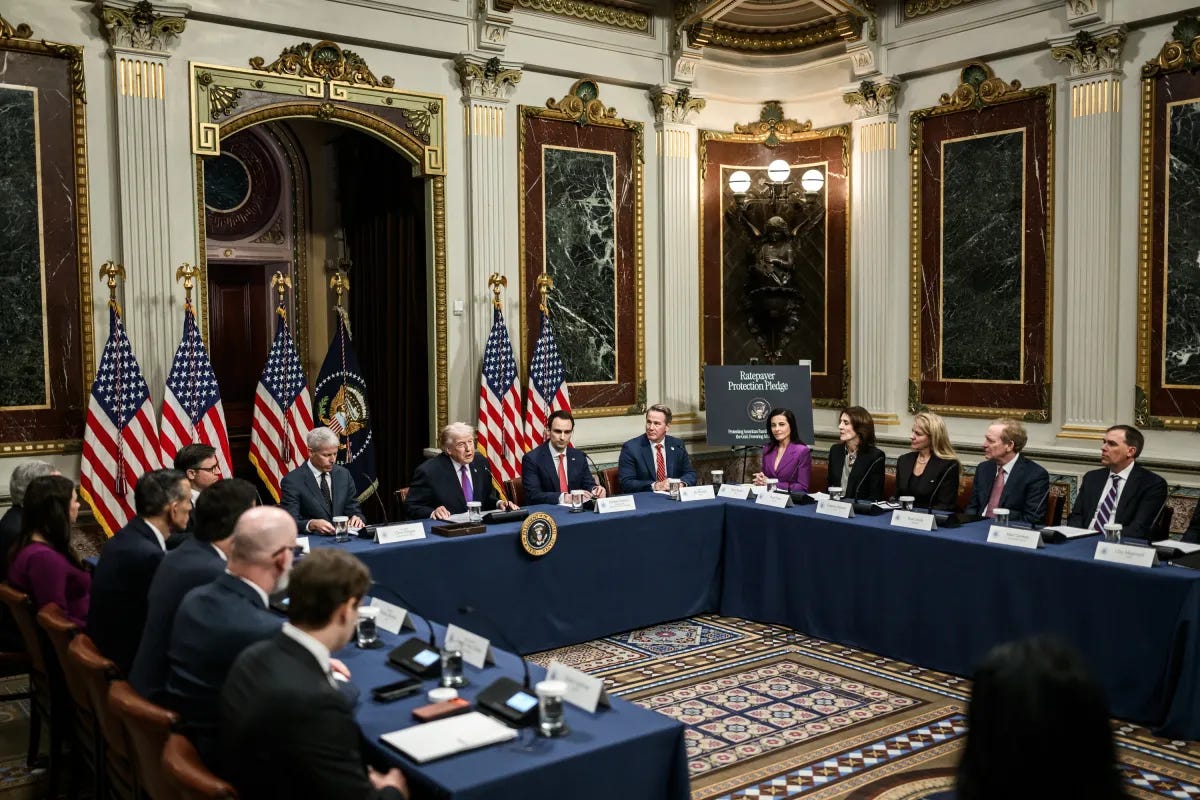
On March 4th, Trump and Cabinet members hosted AI companies for the “Ratepayer Protection Pledge Roundtable” at the White House. What was covered in the media was that the big AI “hyperscalers” were agreeing to pay for and build the electrical power plants that will power the tsunami of AI data centers they say are coming.4
Current forecasts are that projected AI data centers can require the output of the equivalent of 100 large nuclear power plants by 2035! 5 Currently, $3-4 trillion dollars of investment is projected in artificial intelligence and AI data centers over just the next five years.
Set aside whether all these trillions of dollars of investment will be made, and likewise set aside for the moment all of the various hyperbolic (and dystopic) predictions about the impact of AI. Here the reader is asked to consider something else.
How are these AI or Big Tech giants -- Google, Meta, XAI, Oracle, and so-forth -- going to FINANCE their power plants? A recent Fortune magazine article headlines that Google, Meta and Oracle are already, “on a $1 trillion dollar borrowing spree.” While the biggest of these companies do have large cash flows and reserves, borrowing is a critical need, and is already being drawn in from money-center banks, through bond sales, private equity investments, and private credit firms.
Note that this is capital -- and its lending or investment into AI displaces other investments, particularly short-term, speculative money market funds and financial derivatives. Instead it is being invested to build a hundred gigawatts of real-world baseload power plants. (Wind and solar do not cut it for AI hyperscalers; to operate AI data centers requires guaranteed power 99.999% of the time.) Perhaps half of this working capital will be generated domestically, and the plants and equipment built over a decade. These projects also require the skills of hundreds of thousands of experienced and newly trained-up American tradesmen and engineers -- just to build the baseload, 24/7 power plants.
While the AI boom has both winners and losers, these power plants will overall provide substantial additional US baseload power, ‘behind the meter’ or to the US electrical grid.
2. The Military Industrial Complex Will Follow Orders
Consider, in the same light, the recent drubbing that the Big Five defense contractors came in for from the President. Lockheed Martin (LMT), Boeing (BA), RTX (RTX), General Dynamics (GD), and Northrop Grumman (NOC) have been read the riot act. There is a new sheriff in town.
By Presidential Executive Order the Commander-in-Chief and Secretary of War cracked the whip; and after all, the Department of War is the buyer of US defense contractor product. The Executive Branch has asserted its Constitutional powers to manage the federal purse, wielding real leverage on behalf of the Americans in uniform and American citizens in general. Any of our recent Presidents could have done this; no President did -- until now. The logistical requirements of the US military operation in Iran have also driven the point home.
There is a further irony is this matter. In an exclusive, Semafor recently headlined, “Pentagon headhunting Goldman, JPMorgan bankers for ‘Economic Defense Unit’. In the March 11th article, Business & Finance editor Liz Hoffman writes, “Uncle Sam wants you, private-equity banker. The Pentagon is building a new team of investment bankers steeped in private equity to invest $200 billion over three years in defense deals, aiming to counter China’s rise...” 6
So, real capital now is to be invested INTO the US defense sector, not bled out of it, as countering China requires investment into America’s scientific and technological cutting edge.
Defense contractors and their lenders & shareholders have been informed by direct Presidential Executive Order of the Commander-in-Chief: cost-plus contracting is now the exception; and DoW contracts must be delivered -- surprise! -- on time as it is America’s sons and daughters whose lives are on the line. Further, lucrative defense corporate stock buy-backs are to end; executive pay is slashed; and honest profits made from US defense contracts are to be substantially plowed back into technologically upgraded plant, equipment, and the precious American workforce.
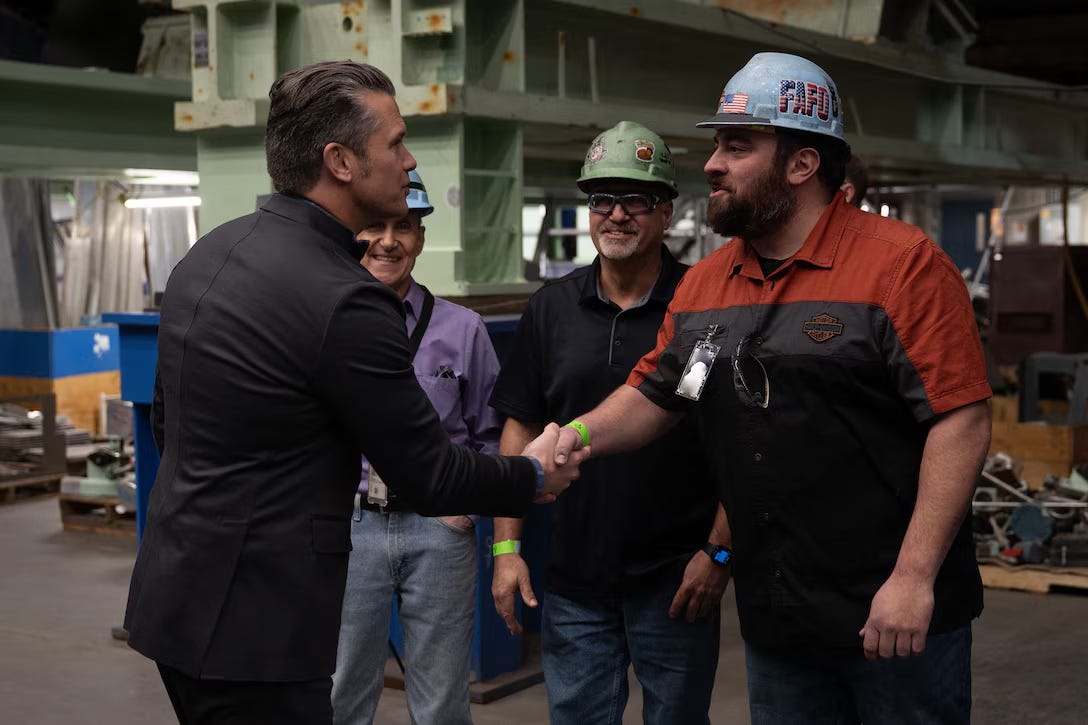
Going forward, if a defense prime contractor and its financial lenders want a federal defense contract, then the DoW now requires that required levels of capital be invested into R&D and advanced manufacturing, insuring that quality product is delivered on time, or in advance of schedule.7 This is the American System of Political Economy in action.
Whatever the Defense budget going forward, it will not be “a windfall” for the Big Five defense firms. The Trump administration and Congress are committed to reinvesting heavily into new science and technologies to insure that the nation has, “the most lethal fighting force in the world.” This is also why the Trump administration, instead of budget cuts, increased the military defense budget by 13%, pushing spending over the $1 trillion mark.
Defense primes like Lockheed Martin are already responding with multi-billion dollar capital investments to accelerate production and deliveries. In addition, Big Tech & AI companies are also finding out that the Department of War is no longer a compliant rube: the tale of Anthropic PBC’s misguided showdown with the Department of War, whatever the ultimate outcome, has been duly noted. The current, ongoing restructuring of NASA’s Artemis program, to settle the Moon, should also be considered in a similar light.
3. Mining: Long Out of Sight and Out of Mind, But No Longer
As the Trump Administration now completes the demolishing of Anglo-Dutch “petro-dollar” power which depends on Middle East oil, it is useful to turn here to the shake-up of the globalized metals trade market.
First off, the denizens of the globalized metals market, centered in the City of London, realized that a “strategic choice” would likely occur in 2025-2026. The choice would be either a further consolidation, a globally embraced “digitized transparency” which would enhance metals market control over manipulated shortages and globalized minerals pricing, or there would be “increased fragmentation” due to regulatory and trade policy pressures as nations rebelled. They were worried specifically about Trump’s 2024 election victory and second presidential term.
On February 4, 2026 Secretary of State Marco Rubio and Vice President JD Vance convened the Critical Minerals Ministerial in Washington, DC. Long prepared, the Ministerial and it intended outcomes are an example of how the ‘fun’ is being taken out of once-lucrative, predatory commodity speculation. What is to replace it is new nationally-steered capital investments into minerals and metals, and processing capacities.
Here, commodity speculators have certainly served as their own worst enemy. Financial oligarchs’ promotion of widespread speculation has killed investment into new mining and processing projects for decades, including into such metals as iron, nickel, cobalt and lithium. Outsourcing was an extension of short-term “money, money, money” insanity. Monopolistic, concentrated ownership and vast global shortages (”shocks”) were deliberately created in chosen minerals -- and not just rare earths.
This can be seen now, again, in the manipulation of oil and natural gas prices in the global energy market, despite the fact that there are plenty of fossil fuels, waivers are in place removing sanctions on Russian oil and gas, and oil tankers selectively move through the Strait of Hormuz on a daily basis.
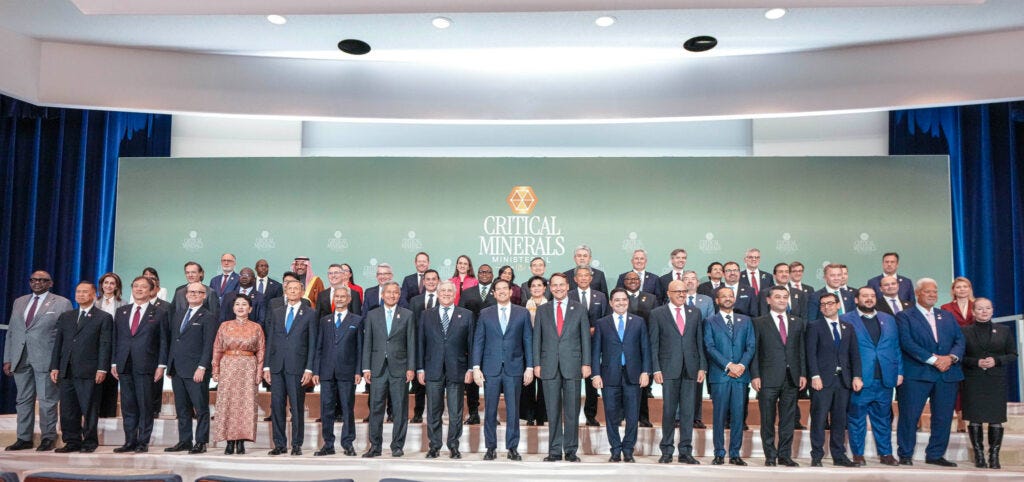
The Critical Minerals Ministerial was convened by the US Secretary of State in Washington, DC on Feb. 4th. Representatives of 54 countries and the European Commission, including 43 foreign and other ministers were hosted -- countries representing two-thirds of global GDP. Little covered in the legacy and social media, keynote speaker JD Vance spelled out the Trump administration’s intent to take pricing away from nations like China but also away from speculators.
While this writer covered JD Vance’s speech in his February 16th Substack post, here is a key excerpt:
...The benefits will be immediate and durable. Regardless of how much material flows into the global market, prices within the preferential trade zone will remain consistent. Over time, our goal within that zone is to create diverse centers of production, stable investment conditions, and supply chains that are immune to the kind of external disruptions that we’ve already talked about.
It is important that mining company executives, particularly in the rare earth and tungsten sectors, reportedly welcomed this American initiative. The U.S.-led effort, in so far as it is aimed at creating an integrated, non-Chinese supply chain, aligns with their own strategies. The mining industry has also largely welcomed the U.S. government taking direct equity stakes in new mining projects, and the February 6th announcement of $12 billion in initial federal funding for a US strategic stockpile for manufacturers, named “Project Vault,” also aimed at putting a floor under mineral prices to prevent dumping.
The City of London itself, the global center of the predatory trading in oil, metals, and money laundering, has other plans. As Chatham House senior fellow Christopher Vandome dryly expressed it, the US Administration’s policy may not last long enough for investors to commit the billions of dollars to mining and mineral processing projects that can take 10–15 years to mature.8
Nonetheless, reality sets in. Take for example Mckinsey & Co, a confidential advisor to corporate elites and public-sector leaders, and whose current Global Managing Partner is a graduate of Oxford University. The Mckinsey & Co. March, 2026 report antiseptically admits:
Access to core commodities—which are critical foundations for growth and innovation—is increasingly seen as a competitive advantage. The move from “stable multilateralism” to a more pragmatic, flexible “minilateralism” based on common interests could continue in the years ahead, resulting in greater focus on security of supply and self-sufficiency.
Some governments are aiming for more physical control and diversified supply, leading to uncertainty about future trade patterns and subsequently rebalancing physical supply beyond purely market-based logic. On this point, more frequent geopolitical intervention typically entails trade flow reconfiguration, which ultimately leads to increased volatility.
“Rebalancing physical supply beyond purely market-based logic.” Yes, indeed. The era of predatory usury in metals and commodity markets generally is within sight.9
No Limits to Real Growth!
Consider then a quote, that identifies what is happening in energy markets more broadly. (In the following quote, physical merchant traders identify those traders who manage the logistics, storage, and delivery of raw materials, whereas hedge funds are financial speculators focusing on price movements through derivatives.)
The quote, once again, from the McKinsey & Co.’s, A New Era in Commodity Trading, March, 2026:
Strong data analytics and access to the broader flexibility portfolio allowed some physical merchant traders to maintain stable results. By contrast, the mixed results of hedge funds highlight the difficulty of generating profits, particularly when it comes to competing with established players in physical markets. Slowly but steadily, some hedge funds have moved to asset acquisitions to diversify their finance-heavy portfolios as well as to secure access to valuable commodity-flow data. In oil and oil products, several companies refined their investment strategies by prioritizing projects with the highest returns. This was especially the case for European international oil companies (IOCs) reducing investments in green energy-transition technologies (mainly offshore wind) to fund renewed hydrocarbon ambitions.10
The shift, including out of insane green energy swindles into hard investments, is a big change for corporates, including those operating in the European Union space! The hydrocarbon (chains composed entirely of carbon and hydrogen atoms) investments referred to in the quote, above, are primarily used as fuel (gasoline, propane) and in manufacturing plastics, lubricants, and chemicals.
Ending Volatility, Going Nuclear
Increasing volatility resulted from the kind of liquidity that was poured into commodity markets, in the post-COVID period and then again with Russia’s military operation in Ukraine. It drove up costs to end-users, the actual producers of physical wealth, including our farmers. With access to deep liquidity, provided by City of London and Wall Street banks, predatory commodity outfits including hedge funds (ie speculators) merely moved the money, targeting volumes of cash and leverage into stressed markets, subjecting pricing to wild swings on the up-side.
In contrast, directed investment of capital into expanding physical production and advancing technologies means an end to shortages and speculation. It brings prices down. So it is with energy; this needed energy just has to be created by Man.
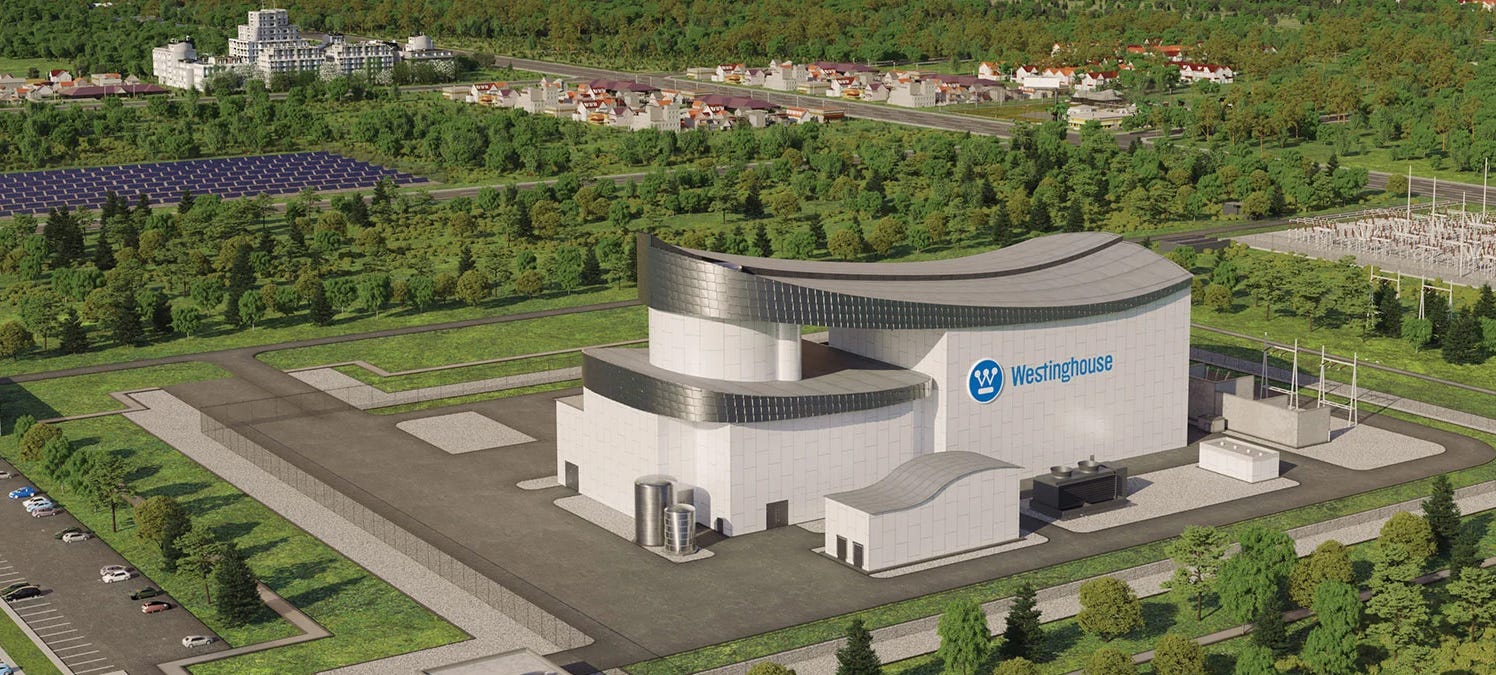
In addition to fossil fuels and their carbon chains, domestic private investment is being drawn into nuclear baseload domestic energy projects in the USA -- not green crap -- and going well beyond the concerns of AI hyperscalers.
The Department of Energy’s (DOE) January 28th Request for Information (RFI), asking for states seriously interested in sponsoring soup-to-nuts nuclear campuses to step up, is a recent case in point. (There is no fooling around, as all responses are due by the beginning of April.) These nuclear campuses will serve to ‘bridge’ between nuclear energy construction companies, utilities, state governments, and private sector investments.
These campuses, to be built around the country, will each site multiple nuclear power plants, fuel development, supply chains, workforce programs, and nuclear science. They are to be supported by DOE loans and DOE loan guarantees as the DOE is also funding an accelerating programs of advanced nuclear fuel development, and engaging the US National Laboratories in a range of public-private nuclear applied science initiatives, including the important work in fusion energy.
Calling the Shots, Carrots & Sticks
Yes there are Carrots. These tools in the Trump administration tool box have been reported in prior posts here on Physical Economics. The US government is taking equity stakes in rare earth mining companies; organizing South Korean and Japanese investments into US shipbuilding and nuclear power complexes; and those “hyperbuilders” of AI data centers are promised federal clearances, to build their own power plants, in one to four weeks. Just as the President already did for big Louisiana LNG projects jammed up for a decade in regulatory morass.
To top it all off, President Donald Trump has ordered the US Development Finance Corporation to offer oil tankers reasonably priced insurance through the Strait of Hormuz, even if Lloyds of London won’t! And don’t forget, there are also the 100% write-offs on capital equipment purchases and new factory builds, as part of the One Big Beautiful Bill Act.
There are also sticks, and anti-trust action is certainly among them, as additional tools deployed to GROW the real economy. For example:
The “big four” meat packers -- JBS, Cargill, Tyson Foods, and National Beef—are now under a magnifying glass. On December 6, 2025, President Trump issued an Executive Order directing the DOJ and the Federal Trade Commission (FTC) to establish task forces to investigate “foreign-owned meatpacking cartels” and potential price-fixing in the food supply chain. These companies have long controlled at least 85% of the U.S. beef processing market.
The big “publicly traded” home builders, like Lennar and D.R. Horton, have been put on notice regarding high housing costs, with the President comparing them to the OPEC oil cartel and urging them to increase production or face potential antitrust scrutiny.
If the reader gets the idea that these new, broad-scale capital investment actions are really modern descendants of the thinking and dirigist policies of George Washington’s Treasury Secretary Alexander Hamilton; of Abraham Lincoln and Henry C. Carey; of Franklin Roosevelt; and of John F. Kennedy, you are so right!
https://www.parnassus.com/insights/article/cio_outlook_3q25__fast_lanes_and_fundamentals
https://www.ml.com/articles/washington-update.html#:~:text=%E2%80%9CEquity%20volatility%20should%20eventually%20fall,could%20surprise%20to%20the%20upside.%E2%80%9D
https://am.jpmorgan.com/content/dam/jpm-am-aem/americas/us/en/institutional/insights/portfolio-insights/ltcma-full-report.pdf
https://www.whitehouse.gov/articles/2026/03/president-trump-secures-historic-commitment-to-keep-electricity-costs-down-amid-data-center-boom/
https://nam.org/u-s-data-centers-may-need-even-more-power-35305/?stream=series-input-stories
https://www.semafor.com/article/03/11/2026/pentagon-headhunting-goldman-jpmorgan-bankers-for-economic-defense-unit
Hegseth speech at SpaceX, January 12, 2026:
https://rareearthexchanges.com/news/can-washington-promise-a-decade-trumps-critical-minerals-gamble-meets-the-time-test-problem/#:~:text=The%20United%20States%20has%20launched,10%E2%80%9315%20years%20to%20mature.
Read the March 20th U.S.-Japan Action Plan, on Critical Minerals here: https://ustr.gov/sites/default/files/files/Press/Releases/2026/U.S.-Japan%20Critical%20Minerals%20Action%20Plan%203.19.2026.pdf
https://www.mckinsey.com/industries/energy-and-materials/our-insights/at-the-threshold-of-a-new-era-in-commodity-trading
I'm wondering if these big tech companies we all learned to hate post-covid were read the riot act and were told to use publicly available patents to build AI data centers powered by Tesla free energy. Then when all is said and done, the government will use their modifications to these open source patents to rebuild the grid to use free energy. Rather than blabbing these intentions to the press, the Administration is using AI data centers as a pretext to their real intent.